Tuesday, 4 February 2014

Chorizo hash

Today I am posting a very simple meal which everyone loves. I think I first discovered this in an Italian restaurant in Clapham about 20 years ago. I am not sure if I remembered or copied it correctly but this is the way I have always done it. The trick is to use good quality chorizo, a nice spicy one. We had it last night and the kids all fought over the crispy bits stuck to the bottom of the pan.

  • 4 or 5 spicy chorizo sausages.
  • About 6 – 8 good sized potatoes sliced into 1cm chunks
  • A large head of broccoli
  • 2 large cloves of garlic thinly sliced.


Put the potatoes into boiling salted water for about 5 minutes. You want them partly cooked. Slice the chorizo and garlic and cook with a little oil in a large pan. I use a paella pan. After about five minutes add the drained potatoes and sauté until the potatoes and sausage are cooked through and going a bit crispy. You need to keep moving them about in the pan. Finally add the broccoli and toss them in the potato chorizo mix and season with salt and pepper. Bring to the table and dig in.

Monday, 3 February 2014

Bedouin Bread

Over the past year or so I have been making more and more bread. Every other day or so I make a sour dough or yeasted loaf but I suspect the breads my children like and will remember the most are the flat breads. I have already written a post on pita but today I thought I
would write about Bedouin flat bread. This is Dominic’s recipe really since he was the one who persevered in finding an alternative to a saj (a kind of upside down wok that the Bedouin use to cook these breads) and he has experimented with different ratios of flour to water.

   We discovered this unleavened flat bread a couple of years ago on holiday in Jordan. Whilst staying in a hotel owned and run by Bedouin we visited a woman who made flat breads for the hotel breakfast in her cooking tent. Whilst we did see modern gas powered saj’s, mostly these breads are cooked under an open wood fire giving them a lovely smoky taste.

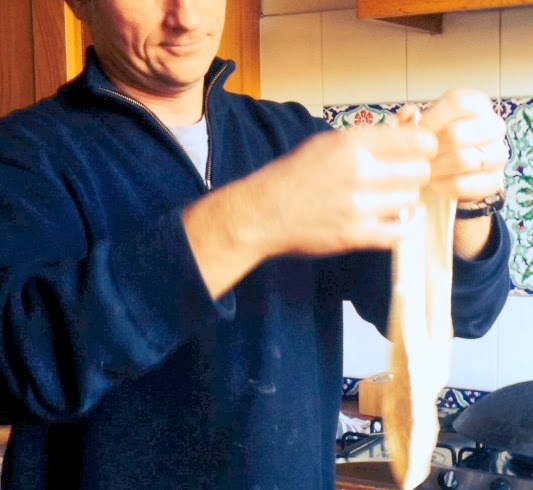
When we have made them at home they almost always become a team effort (in much the same way that the bedouin women make them.) Dom, Josh and I made the ones in the picture at the weekend. We will be trying it out on a wood fire in the garden this summer.

  • 4 cups of bread flour
  • 2 ½ cups of water
  • 2 teaspoons of salt.
Mix into a dough and kneed for about 10 minutes until soft. Split the dough into balls a little bigger than a golf ball. Cover with a damp tea towel and leave for about 10 minutes to rest. Roll out the first ball using a rolling pin and adding flour to avoid it sticking. Pick up the dough and stretch it out gently until the bread is paper thin. Carefully spread it on the saj and leave for just a few seconds. Turn the bread over and cook the other side for the same amount of time.

You can fill the bread like a wrap, dip it in hummus and soups or simply rip it up and eat it plain.

Friday, 31 January 2014

Sally's stuffed pancakes

This unashamedly 1970’s dish was made by my mother when I was a child. I suspect she got it originally from Delia Smith. I have added a few bits and pieces over the years and this is now one of my favourite stand-bys. I sometimes make half with spinach and half without, to appease any children who still resist the idea of too much ‘green’.

  • 8 pancakes (made with 1 egg, half milk half water and a pinch of salt)
  • A large tub of plain cottage cheese
  • About 400g of spinach
  • Two tins of chopped tomatoes
  • Two onions finely chopped
  • Two cloves of garlic
  • About 2 tables spoons of fresh chopped basil
  • Grated nutmeg


Gently fry the onion and garlic in a little oil for about 10 minutes, make sure they are well cooked and transparent but not brown. Add the tomatoes and basil and season with some salt and pepper. Let this cook with a lid on for about 30 minutes.

Steam the spinach for a few minutes until it is wilted and soft. Squeeze any excess water out and chop up. Add about 3 teaspoons of spinach and the same of cottage cheese onto a pancake. Grate a good sprinkling of nutmeg and roll the pancake up into a fat cigar. Line the stuffed pancakes in an oven proof dish and pour over the tomato sauce. Cook the dish for about 40 minutes at 180 degrees. Sprinkle a bit more basil on the top before serving.

Thursday, 30 January 2014

Banana Loaf

I made this cake last night because I discovered three black banana’s at the bottom of the fruit bowl. Over the years I have tried loads of different banana cakes and breads but I always come back to this one. It is best if the bananas are really over ripe (a good week after the children have refused to go near them is a good rule of thumb). About half the loaf went into school today to sustain Josh through a water polo tournament. In the past I have added chocolate chips to the mix and think walnuts would make a good addition. However Josh is allergic to walnuts so I have never tried this.

  • 225 grams of self raising flour
  • 100 grams of soft butter (it has to be really soft but not melted)
  • 4 very ripe bananas
  • 30 grams of soft dark sugar
  • 4 table spoons of golden syrup
  • 4 eggs


Use an eclectic whisk or food mixer to whiz up all the ingredients. Pour into a loaf tin. I use a silicon loaf tin which I don’t need to line or grease. If you don’t have one of these you need to grease the tin with butter and line it with grease proof paper.

Cook in a hot oven at 180 degrees for about 50 minutes. Check the oven after about 40 minutes, if it looks like it might burn cover it with a bit of silver foil and keep cooking.

Wednesday, 29 January 2014

Sarah or Janie's mincemeat

Guest Post

My first guest post comes from Sarah. Sarah gave me this recipe at least 10 years ago and I have been making it every year since. I always try and make sure I don’t use it all at Christmas so that there is some left over to add to apple strudel (you will have to wait for that one). So over to Sarah

I’m actually making marmalade this morning, using the recipe off the side of the cardboard box that contained the Seville oranges!

The jam jars I will use for the marmalade were recently full of Christmas mincemeat. This is really easy to make and so much nicer than shop-bought mincemeat (I have a bit of a ‘thing’ about suet…) This recipe is one I’ve been repeating for about fifteen years now. In my handwritten recipe book, it has the heading ‘Janie’s mincemeat’. Janie is my twin sister who lives in Boston, USA, and tries to keep some English food traditions going in her family. I generally make it during the October half-term when Cox’s apples are cheap, or even free, if you know anyone with a few apple trees. This year, one of the big storms ripped through Suffolk during half term, leaving a deep circle of apples beneath each apple tree in my parents’ garden.

Janie’s mincemeat
  • ¾ pint cider (or apple juice)
  • 1lb soft brown sugar
  • 4 lb Cox apples, peeled, cored and chopped into small pieces
  • 1tsp mixed spice
  • 1tsp cinnamon
  • 1lb 4 oz currants
  • 1lb raisins
  • (4 oz preserved cherries – if you have them in the cupboard – or replace with raisins)
  • grated, unwaxed lemon zest and juice of a lemon
  • ¼ pint Brandy

Dissolve the sugar slowly in the cider/apple juice and then add the rest of the ingredients except for the brandy. Cook for 30 minutes until the apples are soft. Leave to cool until cold. Add the brandy. Put into jars that you have sterilised by washing them extremely well and drying them in a low oven.

Pita Bread

Pita bread is relatively new to our family repertoire but has become a firm favourite. It has many merits; they are easy to make, delicious and never fail to impress guests. They are great, for barbeques, picnics and soups. Possibly best for school lunches but there never seems to be any left over for these. I have, from time to time added seeds to the pita dough, such as poppy or caraway but this is the basic pita.


  • 500 g of white bread flour
  • 350 ml of tepid water
  • 1 tea spoon of dried yeast
  • 1 tea spoon of salt.


Mix the flour and salt in a bowl. Dissolve the yeast to a small amount of water and leave for a few minutes. Add the yeasty water and the rest of water to the flour and mix into a dough with your hands. I them put in the food mixer with a dough hook for about 10 minutes but you can knead it with your hands for about the same amount of time.

Leave the dough in a clean oiled bowl covered with cling film for an hour or two. Now you can knock the dough back and divide it into about 15 small round balls. Leave of a well floured surface and keep covered with a slightly damp tea towel. The oven has to be very hot about 220 degrees C and put a flat baking tray in the oven to get it really hot too. Roll out two breads to less than 0.5 cm thick. They should be about the size of a small plate. Put them onto the hot baking tray and cook for between 3 – 4 minutes. Once done put them on a large plate and keep them wrapped in a tea towel. The pitas will puff up like balls and watching them do this never fails to give me pleasure. While one batch is cooking roll out the next two and carry on until you have a beautiful heap of pita breads.

Tuesday, 28 January 2014

Chicken murag with rice

Having caused a bit of a rumpus with the simplest of all meals (scrambled egg) I feel like I am taking my life in my hands with this post. This dish sends my brother and I into raptures of nostalgia. Cooked by our grandmother it fills the house with smells of chicken and spices, it is essentially chicken soup with rice. I have found other versions of this in Claudia Roden’s Middle Eastern food book but none are quite the same as our version. My grandmother, Rachel grew up in Calcutta, her family were part of a small community of Jews who over the preceding 100 years had come to Calcutta from Baghdad and Syria. This recipe has clearly been influenced by this Indian and Middle Eastern background. My grandmother did not use stock for this soup just water. The chicken bones cook in the soup and its own stock is created. But when I have a good fine clear chicken and onion stock i thinkit adds to the flavour.

Its best on a cold night when you are feeling low or after a long walk when all you want is comfort food. I have given you the amount I tend to use for four people but I often double it since it tastes better the next day. I recall my grandmother used to top up the murag the next day with more potatoes and chicken added to the left over broth.

  • 6 Chicken thighs on the bone and skin on
  • Potatoes (you don’t want them too floury, they need to stay firm when boiled)
  • Chicken and onion stock if you have homemade.
  • 1 onion finely sliced
  • 2 teaspoons of cumin seeds
  • 2 teaspoons of corriander seeds
  • 2 teaspoons of Ground turmeric
  • 8 -10 Cardamom Pods
  • 3 Garlic cloves
  • Basmati Rice

For the murag Crush the Spices, (except the cardamom) finely slice the garlic and onion and add them to a pan with a splash of sunflower oil. As it starts to bubble add the chicken pieces and brown them off in the spice mix. After a few minutes add the chicken and onion stock and enough water to cover the chicken well (you want lots of broth). Add the cardamom when you add the liquid.

I make a chicken stock by boiling up chicken bones and a couple of peeled and halved onions. If you don’t have any stock, just use water. The last thing you want is to use a stock cube which ruins the flavour.

Let the chicken, spices and chicken simmer for about 20 minutes or longer you want to the chicken to just fall off the bone then add about seven peeled and halved potatoes. (keep the potatoes quite large.) and simmer for another half and hour or so. The skin on the chicken will have started to come away, remove these from the pot and skim any fat from the top of the murag. Season to taste.

For the rice I was also taught to make rice by my grandmother. She did this always using the same pan. She did not measure out her rice, she put it in the bottom of the pan so it covered the bottom. She then added water so that if she put her elbow in the pan it would come up to the same height on her arm. Not hugely helpful if you have a smaller pan, different sizes arms etc! I subsequently found that the best way to guarantee fluffy rice every time is use the same amount of rice to water.

One good sized mug will make enough rice for two people. Rinse the rice well add it to the pan with some salt. Add the water, put the lid on the pan, bring it to the boil and as soon as it starts boiling (do not take the lid off) turn it down to low simmer. Let it cook for exactly ten minutes. Turn the heat off but do not take the lid off, leave it for a further ten minutes. Then remove the lid and hey presto perfect rice. This basic rice can used to make spicy rice but more of that in future posts.

How to eat chicken murag Take a large bowl, add a good spoonful of rice, then add plenty of soup with at least one bit of chicken and one potato per person. I challenge anyone to only have one serving.